MoD should be able to sell at $1.003+withdrawal fees.
My understanding is that this is even more far away from the terms and the intention of the NuBot gateways.
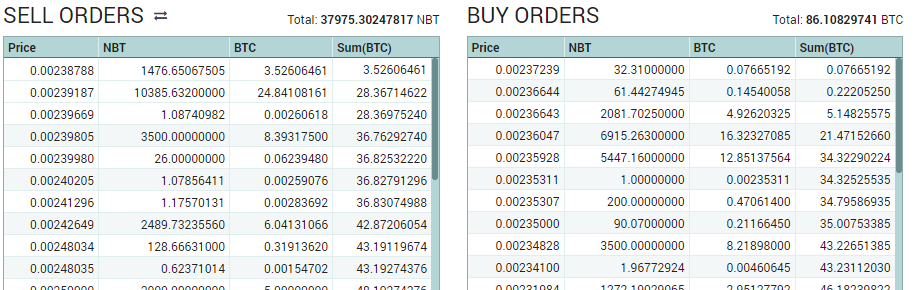
But as @JordanLee didn’t request the NBT nor FLOT, they are still on my account and I can use them in the sell side gateway if the liquidity situation gets dire. At the moment there’s close to 30 BTC on sell side and over 30 BTC equivalent on buy side within the allowed spread:
That would mean the NBT end up at sell side while I receive BTC? What about this:
I read this as implicit agreement to short the buy side and the sell side gateway; or more clearly: to use the NBT traded by the buy side gateway and make them available for the sell side gateway without sending them to @JordanLee just to get them sent back to the NBT deposit address of my Poloniex account.
I really think that Nu needs to consider a combination of providing liquidity with funds owned by Nu and funds by liquidity providers who get compensated for that.
The disadvantage is exposure to exchange default etc. (we all know why we wanted to get rid of that).
But not having liquidity operations with funds owned by Nu leaves Nu with no direct way of steering liquidity volume.
The advantage of doing it is to have direct control over T1.
The compensation to incentivize providing liquidity needs some improvement, before it can be considered reliable.
Blocks & Chains Exchange will change the game completely, because it’s possible to provide liquidity with funds in Nu property with no bigger risk than holding them in multi sig addresses (which FLOT already does).
Meanwhile (before BCE is live and before the incentives to provide liquidity have been adjusted) it might not be the worst idea to provide a kind of “volume floor” on supported exchanges with Nu funded operations (not the compensation, but the funds). The floor just needs to be enough to keep the peg.
Or in one sentence: if there’s nobody providing liquidity at an officially supported exchange (for whatever reason), Nu should at least put [insert number here] USD value on each side.
1 Like
As long as the price is $1.003+fees, you should be free to sell. Anyone holding NBT for Nu should be able to sell at that price at any time.
But what’s the benefit of doing that instead of just using them on the sell side NuBot?
The drawbacks are the need to send (BTC) and receive (NBT) funds, changed exchange rates between sending and receiving funds, the need to trust one party (being trusted with Nu funds, I would require the NBT to be sent first - would @zoro trust receiving NBT from me after having sent the BTC?), etc.
I’m already feeling uncomfortable sitting on 10k worth of NBT on my Poloniex account and feeling an increased responsibility for the peg on Poloniex I literally watched Poloniex the last hours in short intervals.
Trading the funds instead of just putting them in orders is just too much for me without having a proper mandate for it. Just putting them there is bending the rules to some degree.
The terms of the buy and sell side gateways to which the NSR holders agreed to don’t deal with trading the funds. In fact the buy side gateway terms explicitly state that
Shorting that sending process (sending the NBT to FLOT or @JordanLee just to receive them back on the sell side gateway deposit address) by putting the NBT on sell side is as far as I dare to go and only because I read an implicit agreement of @JordanLee to that procedure.
@masterOfDisaster has asked where to sent NBT proceeds from the gateway. Please send them to FLOT multisig address BqyRzFtWXDmjxrYpyJD42MLE5xc8FrB4js.
1 Like
Let me start with: (partly) done!
A detailed explanation follows.
And btw. - I’m very glad to be relieved from the NBT!
Unfortunately blockexplorer.nu is stuck again and I got worried not seeing the transaction although Poloniex reported it as sent. But I started with a withdrawal of 1 NBT to the FLOT multisig address so I didn’t worry too much.
When I realized that blockexplorer.nu is stuck I tried svr1.nubitsexplorer.nu
That explorer is able to show the transaction but is not able to decode the multi sig address script
I remembered another explorer for the NuBits blockchain: https://explorer.coinpayments.net. Huzzah - there’s the transaction and the receiving address!
I sent the rest of what I was able to withdraw in another transaction
Final balance on BqyRzFtWXDmjxrYpyJD42MLE5xc8FrB4js.
As soon as my withdrawal limit has been reset, I’ll send the rest (3,200.26 NBT) to BqyRzFtWXDmjxrYpyJD42MLE5xc8FrB4js.
2 Likes
What follow is probably off topic, please contact me in private if you think we go too much deep into details.
Wait, lets go through it.
The expected behaviour that I was able to test multiple times is this :
If the size of T1 wall is detected to be <10% of the full size of the wall (explicitly declared in config) for more than 4 minutes consecutevly, then the orders are reset
Are you saying that sell walls are not replenished ? not even after 5 minutes of being depleted?
The NuBot used here was configured for buy side only (by configuring sell side to “bookSellwall”: 0.0,). And that worked just fine.
The buy orders must have been replenished. All 25 BTC were traded for NBT without manual interaction (except for restarting NuBot to have the funds put into orders immediately).
Only I don’t know whether the threshold of 10% triggered that or a moving price.
At first sight the trade history on Poloniex doesn’t tell that either.
If you want, you can have the log of NuBot.
From my view everything went fine with the buy side gateway. But you have a PM regarding NuBot in general 
edit: according to the most recent trades on Poloniex it’s a new day:

but my withdrawal limit hasn’t been reset. Maybe it takes 24 hours and not another day to reset it. Will keep an eye on it to send the rest (3,200.26 NBT) to BqyRzFtWXDmjxrYpyJD42MLE5xc8FrB4js.
edit2: the daily limit on Poloniex indeed has a 24 hour reset and is not based on calendar days.
3,200.26 NBT have been withdrawn to BqyRzFtWXDmjxrYpyJD42MLE5xc8FrB4js.
With this withdrawal all NBT that were traded from BTC by my buy side gateway have been sent to FLOT.
This turn is complete with this transaction.
The fiat pairs are still nearly untouched…
Tier1
Poloniex BTC/NBT sell 16028.8223 buy 18169.0998
The Tier 1 sell-side liquidity is critically low.
@henry, could you promote 20000 NBT to Tier 1, and buy 20000 NBT from FLOT, at a rate of 1.00? Thanks.
As of the time of writing:
-
only 3500 NBT on sell side of Poloniex
-
getliquidityinfo reports about 19k more funds in buy side than sell side for tier 2 and 3
-
ALix walls report about 20k more funds in buy side than sell side for tier 1
Can @masterOfDisaster’s NBT exit be used? For once to show it works if @masterOfDisaster doesn’t want - understandablly - this to be a daily job ?
The buy side is greater than the sell side in both NuLagoon and the overall network. We can buy 10,000 NBT from @JordanLee or @FLOT now. Please contact us. Thank you.
I propose to sell 10000 NBT to NuLagoon, at about 0.00234834 BTC each, which is the lowest ask on Poloniex at this moment.
The effective offset is less than 0.2% above 1USD, or about 0.25% above the highest bid (0.00234243). If @henry will deposit 23.4834 BTC to the FLOT BTC address 3QDWJ2yqJ5iTUg6cSpAwxx95ba3NG97hzG, a member of FLOT NBT group will propose a transaction to an address of @henry’s choosing, which may be published or privately told to FLOT.
FLOT BTC buy side shall refund NuLagoon if the transaction cannot gather the consensus of FLOT.
The justification of this transaction:
- Tier 2 and 3 have about 20k more in sell side than buy side (getliquidityinfo)
“2” : {
“buy” : 12278.53,
“sell” : 2928.8772
},
“3” : {
“buy” : 37502.8638,
“sell” : 26510.0 - Tier 1 has about 7.5k more in sell side (ALix walls 15min avg: 28511.5306 vs 36186.8251)
- The actual sell side liquidity as given above is about 41% of total liquidity, and was much lower not long ago
By the way, shall we assume that tier 3 in getliquidityinfo is always up-to-date?
1 Like
The walls changed way too quickly this time.
This can be a case for which the NBT entry gateway was made for - if NBT need to be put on T1 at Poloniex and arranging a trade might take too long.
The deposit address is known to FLOT and @JordanLee.
I verified that it is running (by connecting to the session).
Anybody could verify it by looking at the broadcast liquidity information:
nud getliquiditydetails B | grep BETwD8nSjtj9ADSvej2na34xmsMYwPRymv -A 40
    "BETwD8nSjtj9ADSvej2na34xmsMYwPRymv" : {
        "1:NBTBTC:poloniex:0.3.2a_1449093980642_dd6880" : {
            "buy" : 0.0,
            "sell" : 0.0
        },
        "1:NBTBTC:poloniex:0.3.2a_1449696980204_33797a" : {
            "buy" : 0.0,
            "sell" : 0.0
        },
        "2:NBTBTC:poloniex:0.3.2a_1449093980642_dd6880" : {
            "buy" : 0.0,
            "sell" : 0.0
        },
        "2:NBTBTC:poloniex:0.3.2a_1449696980204_33797a" : {
            "buy" : 2.21,
            "sell" : 0.0
        }
    },
[...]
At the moment the liquidity situation at Poloniex looks fine. Was it corrected by @henry and @JordanLee in the background or did the market correct itself?
That’s why trying to balance from T4 will never work well.
1 Like
I didn’t call for direct intervention by T4. For a good part of an hour Tier 1 sell side was basically 0. So I asked NuLagoon to balance it with Tier 3, and then FLOT to balance NuLagoon. By the time I’ve typed up all the above and sorted out some details, it went up to a more normal range. Now Tier 1 is pretty much balanced, though NuLagoon is not.
There was no other good way to swiftly deal with that situation apart from a responsive Tier 3, which is not available right now, whether it’s your gateway or NuLagoon. Luckily that situation didn’t end up threatening the peg, just wasted my time.
I’m aware of that. It was just another good example for the importance of a working multi tier model with working flows between the tiers.
This will even with fixed cost compensation be the case. But the incentive to monitor occasions like that to earn a lot of compensation with only little invested funds will help mitigating this problem.
Right.
[quote=“dysconnect, post:843, topic:1239”]
By the time I’ve typed up all the above and sorted out some details, it went up to a more normal range.
[…]
Luckily that situation didn’t end up threatening the peg, just wasted my time.[/quote]
Which is bad enough that you wasted your time.
Balancing NuLagoon’s T3 (and other T3s that may come) on a weekly basis could be one of the tasks for FLOT (together with the transfer for the NSR buyback) - one for what FLOT in my opinion was created for.
3 Likes
If 3 FLOT members are always available, it could be a matter of minutes to send funds (as a T3 custodian) to MoD’s gateways eliminating the need of negotiations. The time will be consumed to make the agreement between the 3 FLOT members (via a chat channel i guess) and signing the transaction.