The Safest, Fastest
Asset Exchange on EarthTrade any leading blockchain asset for any other. Protection by Design. No Account Needed.
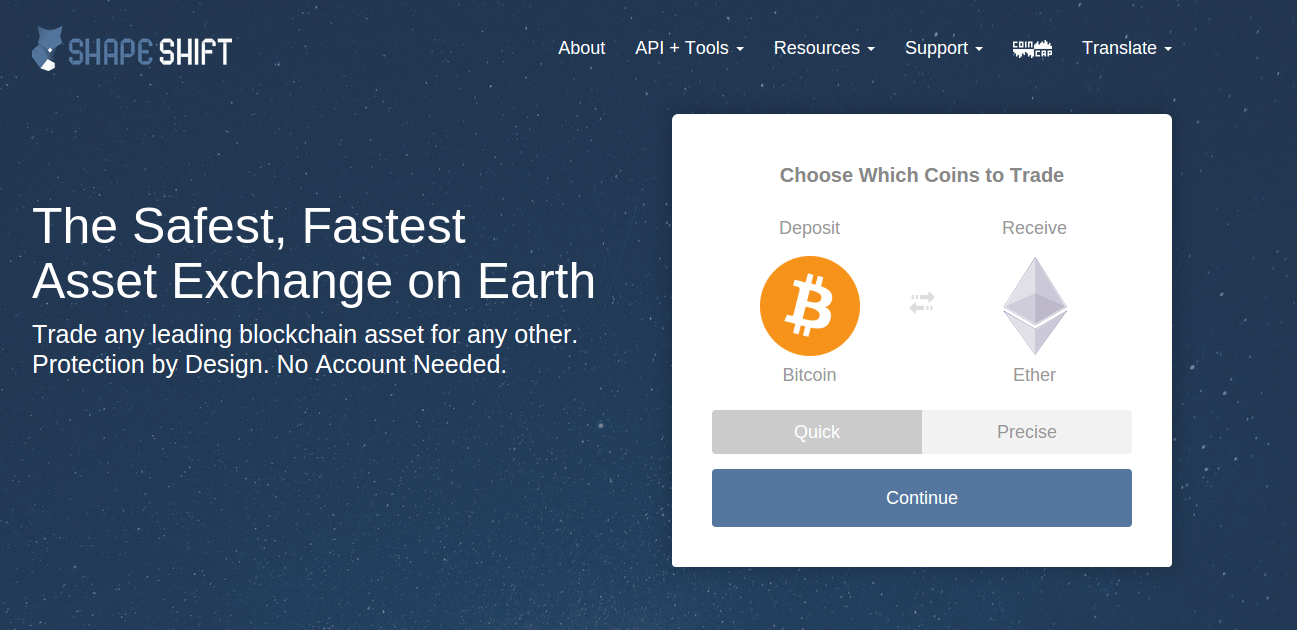
How would B&C Exchange fare and compare to Shapeshift? Any reason for any room for us?
The Safest, Fastest
Asset Exchange on EarthTrade any leading blockchain asset for any other. Protection by Design. No Account Needed.
How would B&C Exchange fare and compare to Shapeshift? Any reason for any room for us?
Hmmm. Maybe I get this wrong, but it looks more like a marketing stunt.
Shapeshift does exchange assets as core business from the start.
It is and stays a centralized exchange, which users, who want to transact big amounts, might not like as much as a decentralized solution with multisig.
You need no account or anything else at Shapeshift, except for a deposit address for your change, which is convenient.
IS THERE A REASON WHY THEY CANNOT BE AS SECURE AS BCEX?
Is there a sweetspot between decentralization, server and regulation protection? Because i suspect there might be a tradeoff between decentralization and speed that users could choose
No need to shout, dude 
I can’t imagine a solution in which a centralized entitiy can get as much trust or credibility as a decentralized exchange can get, which transacts utilizing reputed signers, who besides the reputation have collateral to lose, if they don’t behave.
So the reason why BCE is more secure is found in economic reasons as much as in organizational reasons - BCE runs on a blockchain, is decentralized, has no single point of failure that can be attacked and DDoS’ing is is very costly.
Speed is is by design a drawback of decentralized solutions. It takes time to form consensus.
But I wrote that at another place already: unless you want to withdraw funds that were recently traded, I can’t see a reason that prevents recently traded funds from being used for other transactions, like trading them again, before the trade is written in a block.
0-confirmation tx should be possible hwen trading (which speed up BCE by far).
The necessary information stays in the mempool.
It’s only the reputed signers that can mess things up (whi have strong incentives not to do it) and not the users.
If anything goes pear-shaped, some trades are reverted and the users have their original funds back. Only withdrawing funds before a sufficient number of confirmations are reached, must be prevented.
Great elaboration - that makes sense.
As for the collateral to lose, it seems like centralized ex have collateral to lose when they dont behave well or are attacked.
HOWEVER many small collateral to lose (bcex reputed signers) is more robust than one big collateral (centralized ex) because in the former case personal funds are at stake and profit is less leveraged?
Regarding centralized exchanges and collateral:
name one centralized exchange with references to where the collateral is held and how it can be used to compensate losses for customers.
At BCE the collateral can be kept under control of BCE, but different from the ones who might cheat or cause losses in other ways.
From https://nubits.com/sites/default/files/assets/Blocks%20%26%20Chains%20Decentralized%20Exchange.pdf, page 2, last paragraph:
Alternatively they can confiscate the security deposit and use it to compensate for the losses.
If it’s indeed BKS as collateral, shareholders can of course just burn it and grant a sufficient amount of BKS to sell them and compensate the cheated users.
Lets say coinbase and their capital with the protection of the laws.
They dont want to loose their invested capital so they will try to be operational and save their customers fund – if they have a kind of fin license users get the protection of some jurisdiction insuring their money?
NuBits not available @ ShapeShift anymore… 
It’s only a matter of time.
Shapeshift is rebuilding its infrastructure after the inside job.
back online now ?
Yep, finally!