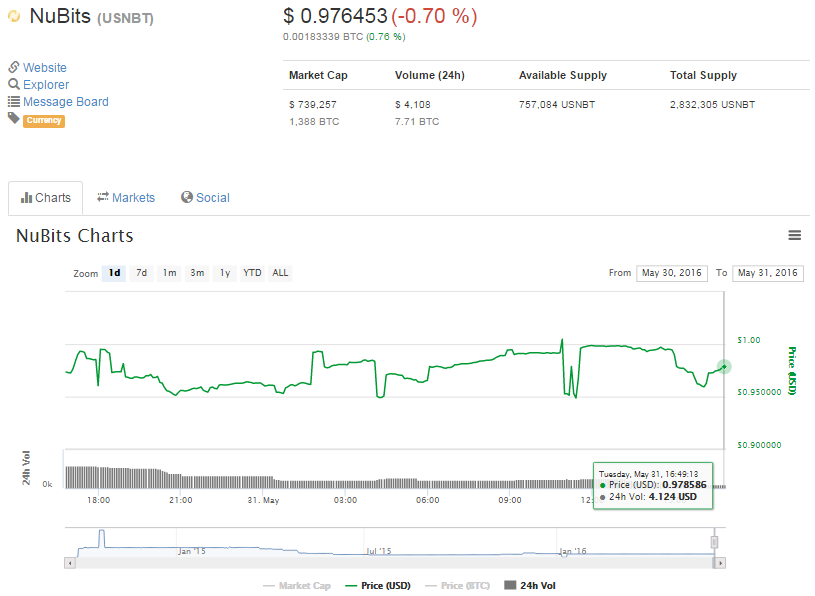
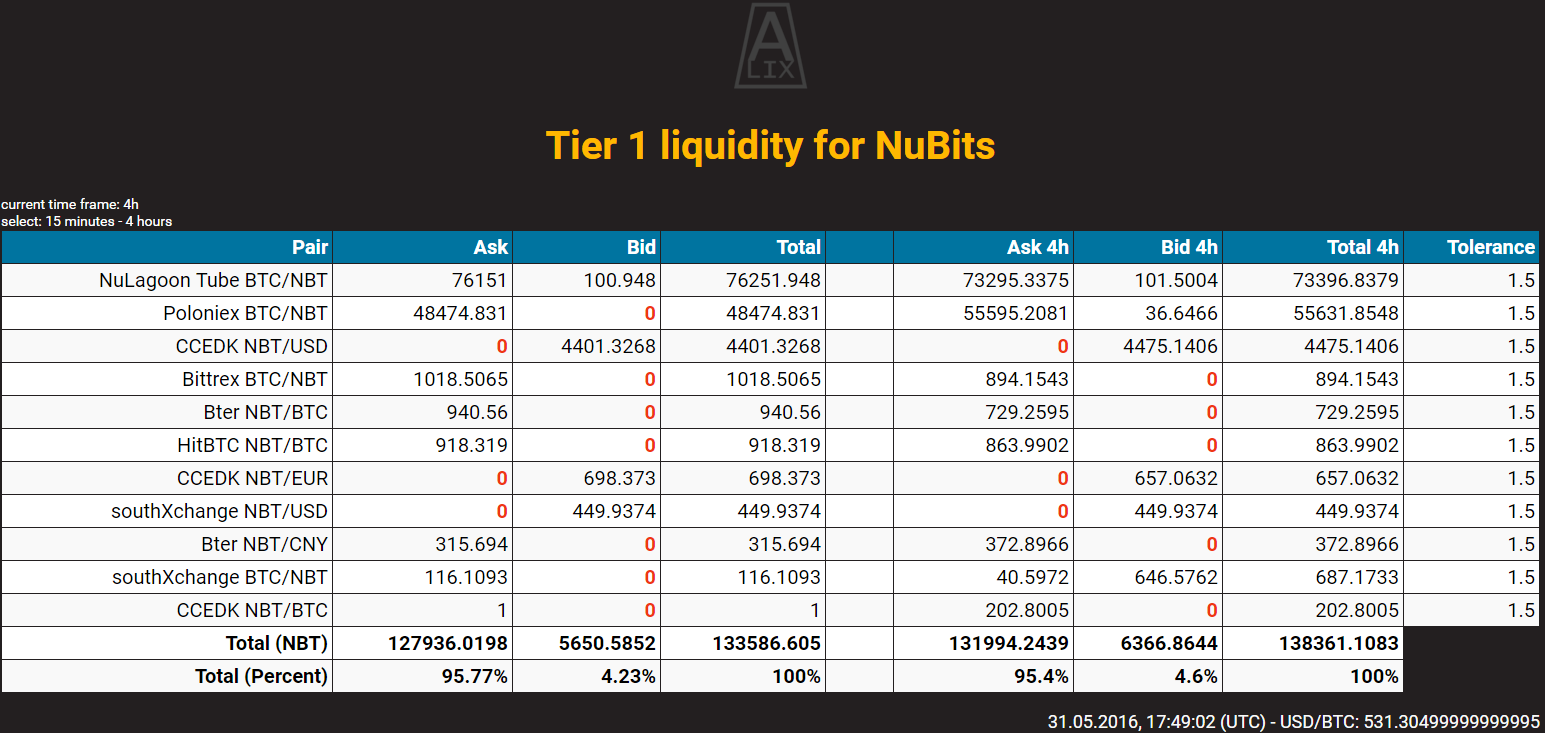
NuBot gateways at a rather high buyside offset and rather small sellside offset are well-funded now:
Mon May 30 15:19:07 UTC 2016
status of mOD dual side NuBot at Poloniex:
nud getliquidityinfo B | grep B9gXptkoqAApF3AFrQyhUbhSzvuEudxupt -A 2
        "B9gXptkoqAApF3AFrQyhUbhSzvuEudxupt" : {
            "buy" : 12210.8,
            "sell" : 20161.9209
status of zoro dual side NuBot at Poloniex:
nud getliquidityinfo B | grep BJs4YbtaqCmxeHLiR6zzjnZEotYVFAPfMo -A 2
        "BJs4YbtaqCmxeHLiR6zzjnZEotYVFAPfMo" : {
            "buy" : 11992.54,
            "sell" : 18692.922
This is a lot of money that could get lost by exchange default.
I’m aware of that.
Everyone should be aware of that.
Yet I don’t see an alternative that is sufficiently reliable.
I don’t have numbers at hand regarding the exco.in and bter losses, but the debt at ccedk from the February 2015 losses alone is above 30k.
Compared to those losses, the money at stake is in a similar order of magnitude.
Without it, there’d be no reliable peg support, although it’s on a degraded level.
The demarcation point of $0.95 could be kept so far.
In my opinion the value for the brand image is far superior to the funds at stake.
If NBT were to drop to $0.50 (no one knows whether that would happen, but we know that $0.95 is the limit as long as BTC in zoro’s gateway remain and $0.925 as long as my gateway has BTC left), the effect on the total value of Nu would likely be far above $60k.
The drop to $0.95 already cost hundreds of thousands of USD in corporate value.
The $60k is peanuts compared to it.
Plus they are not lost - they are just at stake!